

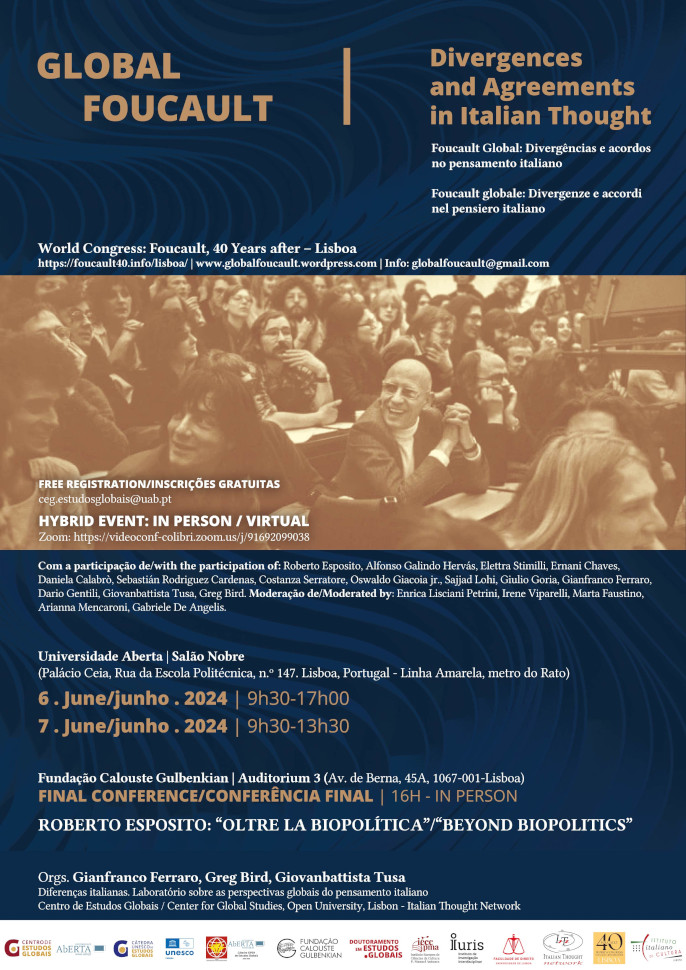
Foucault Global | Conferência internacional | Lisboa 6-7 de Junho 2024
Início: ⋅ Fim: ⋅ Países: Portugal
6 de Junho 2024 / 6 June 2024
Salão Nobre da Universidade Aberta
9h30: Acolhimento institucional do Centro de Estudos Globais e da Universidade Aberta / Institutional welcome from the Center for Global Studies and the Open University: Gianfranco Ferraro
Saudações do Diretor do Instituto italiano de Cultura / Greetings from the Director of the Italian Cultural Institute: dr. Stefano Scaramuzzino
Saudações do co-coordenador do Laboratório “Diferenças italianas” do CEG / Greetings from the co-coordinator of the “Italian Differences” Laboratory of the CEG: Gabriele De Angelis
Abertura oficial do Colóquio da parte do comité organizativo / Official opening of the Colloquium by the organizing committee: Gianfranco Ferraro, Greg Bird e Giovanbattista Tusa
9h50 – 11h50: Biopolítica e pensamento italiano / Biopolitics and Italian Thought
Alfonso Galindo Hervás, Biopolitica. Istituzione. Variazioni foucaultiane di Roberto Esposito / Biopolitics. Instit
Elettra Stimilli, Biopolitica e pensiero italiano / Biopolitics and Italian Thought
Ernani Chaves, Pasolini, pensador da biopolitica / Pasolini, thinker of Biopolitics
Chair: Marta Faustino
11h50: Coffee break
12h00 – 13h30: À volta do Foucault italiano / About the Italian Foucault
Daniela Calabrò, Le “vite infami” e le “attenzioni del potere”. Il rapporto tra politica e vita in Foucault ed Esposito / The “infamous lives” and the “attentions of power”. The relationship between politics and life in Foucault and Esposito
Sebastián Rodriguez Cardenas, El otro, el mismo: Foucault y Agamben entre dispositif y dispositivo / The other, the same: Foucault and Agamben between dispositif and
Chair: Gabriele De Angelis
15h30 – 17h00: Polaridades foucaultianas / Foucauldian polarities
Costanza Serratore, Nietzsche in Foucault. La bipolarità della biopolitica nella ricezione italiana / Nietzsche in Foucault. The bipolarity of biopolitics in Italian reception
Oswaldo Giacoia jr., Exceptio e Bando: Alcance e Limites da Biopolítica / Exceptio and Bando: Scope and Limits of Biopolitics
Chair: Irene Viparelli
7 de Junho 2024 / 7 June 2024
Salão Nobre da Universidade Aberta
9h30 – 11h30: Arqueologias foucaultianas / Foucauldian Archaeologies
Sajjad Lohi, Foucault, l’Iran, l’Italia /Foucault, Iran, Italy
Giulio Goria, The Atlas of Knowledge: Archaeology from an Italian Debate at the End of the Sixties
Gianfranco Ferraro, Conversioni italiane: per un’archeologia del “pensiero vivente” / Italian conversions: Towards an archaeology of the “living Thought”
Chair: Enrica Lisciani Petrini
11h30: Coffee break
11h30 – 13h30: Pensamento dispositivo / Dispositive Thought
Dario Gentili, Governamentalità socialista: sviluppi e differenze nell’Italian Thought a partire da uno spunto di Foucault / Socialist governmentality: developments and differences in Italian Thought starting from Foucault’s remark
Giovanbattista Tusa, I mostri di Foucault. Riflessioni sul dispositif / Foucault’s monsters. Reflections on the dispositif
Greg Bird, What is a dispositif, according to Esposito?
Chair: Arianna Mencaroni
7 de Junho 2024 / 7th June 2024
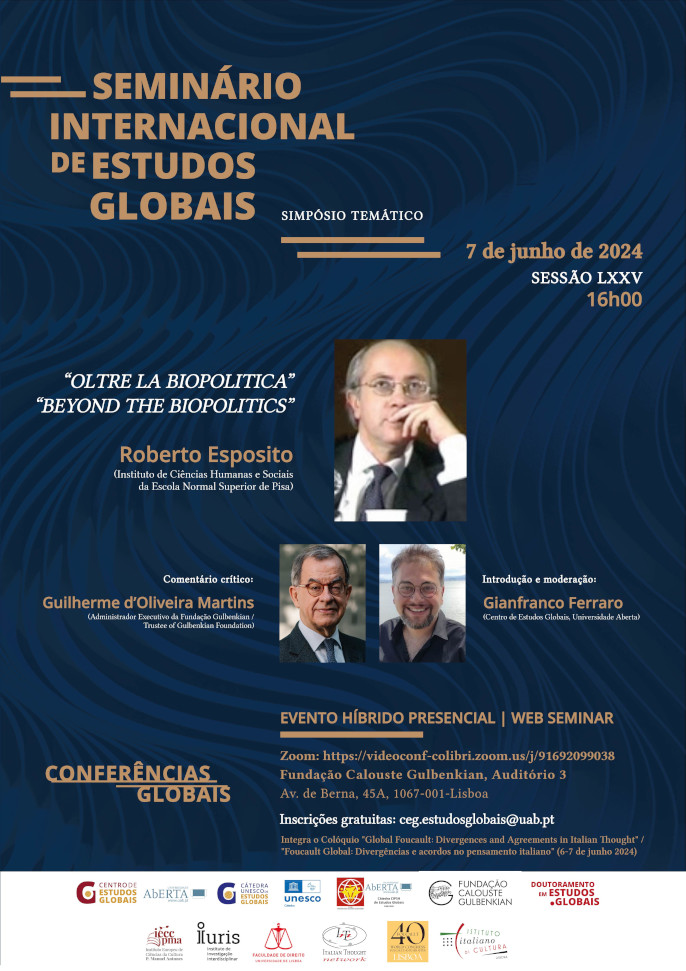
Fundação Calouste Gulbenkian | Auditorium 3
Simpósio Temático com Roberto Esposito
16h: Roberto Esposito: “Oltre la biopolítica” / “Beyond he Biopolitics”
Introduz e modera / Introduction and moderation by: Gianfranco Ferraro (CEG – Universidade Aberta de Lisboa)
Comentário crítico / critical commentary by: Guilherme d’Oliveira Martins (Administrador Executivo da Fundação Gulbenkian / Executive Trustee of the Gulbenkian Foundation)